
It has become commonplace at least in Western culture to know that Jesus has died for our sins. Some take that seriously and try to change their lives for the better on their own. In so doing they create new rules to keep them from even getting close to wrongdoing or sin. Others take God’s grace for granted and use it as an excuse to sin. These people’s lives look no different than people outside the Church. However, I believe that for many churches and denominations, the people are only being told about one part of the story.
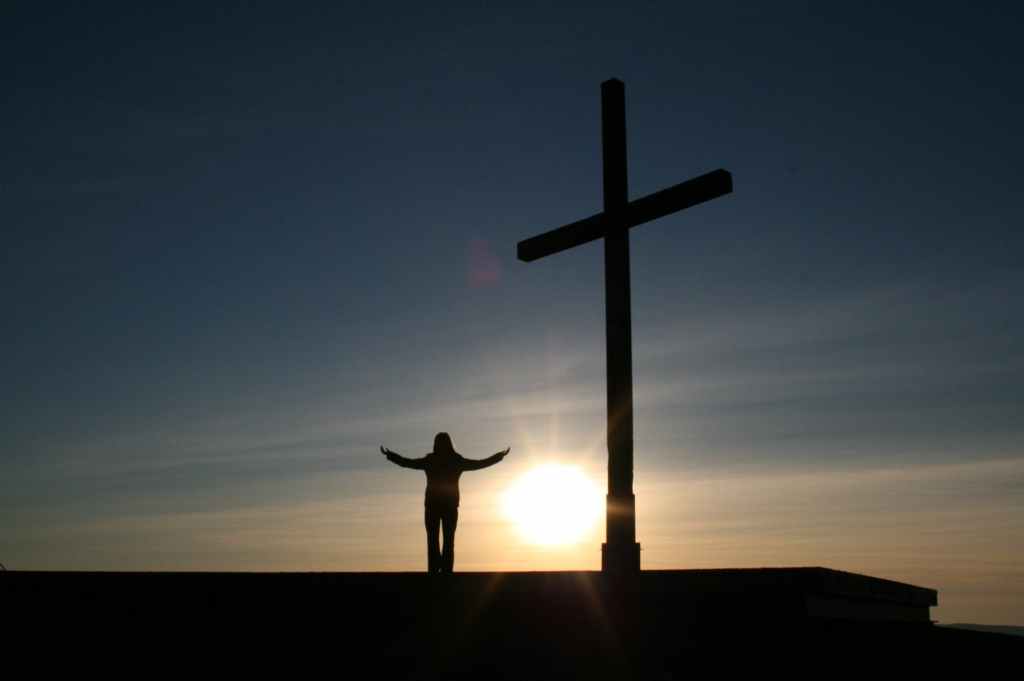
“16 For God so loved the world that he gave his only Son, so that everyone who believes in him might not perish but might have eternal life.” -John 3:16
However, this is only half of the Gospel. The other half of the Gospel is that Jesus Christ didn’t remain dead; he rose from the grave. His new life is a promise that someday we too will rise from the dead. The interesting thing is that that resurrected life can begin even before we are dead.
The First Half of the Gospel: The Need for a Sin-Taker
The first part of the Gospel is that our sins need to be taken away. In the beginning, God created the world and put humanity in charge of it all (Genesis 1). He then gave humanity a choice: to obey a simple command or give in to curiosity, to gain God’s knowledge through a different route than from God himself. This would in effect give humanity the power to be its own god. This was the choice at the Tree of Knowledge of Good and Evil (Genesis 3). It was a choice that seemed beneficial at the time, but once the fruit was eaten, shame gave way to the realization that they were naked. They tried to clothe themselves to hide their shame, because they knew they had done something wrong.
Through this action sin entered humanity. Innocence was lost. Humanity once depended on God for knowledge of things good and evil, but now mankind had obtained the knowledge itself. It is this knowledge that teaches children to lie to their parents. It is this power that is now in humanity’s genetic code, so to speak, that makes us inherently want to harm others, take advantage of others, have power over our own lives and live in a state of pure ecstasy and pleasure at the expense of our own health and well-being and that of those around us. We feel we ought to be able to make our own rules and live without the consequences of our own decisions.
However, there are always consequences when our choices are made against the way God has designed us; that is against his Law. Before the Law was given, people had to live by faith and to keep order in ancient societies, some civilizations picked up on the natural laws God had originally set up. This is probably why Hamarabi’s code is a lot like the Ten Commandments. God’s nature can be seen in His creation.
All across the world, different peoples and tribes have come up with ways to atone for their wrongdoings. This was first established when God provided clothing to cover the man and woman’s nakedness, at the sacrifice of an innocent animal (Genesis 3:21). Their children continued this practice of sacrifice, one sacrificing animals (Abel) and the other sacrificing part of his crops (Cain). Each did it to regain God’s favor. One received it because he had purer motives. The other did not receive the favor, because of impure motives. And thus, the first murder occurred over jealousy of God’s favor.
And yet, all ancient peoples, even those who believed in multiple gods and worshiped idols, felt like humanity didn’t measure up. God even revealed this when He gave the Israelites the Law (Exodus 20). God gave them instructions on how to atone for all kinds of different and specific sins..
Yet even those nations who did not know Jehovah God offered all kinds of burnt offerings to appease their own gods. Some societies even recognized that the blood of animals wasn’t enough to cover sin. Even children and people were sacrificed to gain the gods’ favor. Such were the efforts to overcome humanity’s own evil, and yet it was with evil by taking innocent life that it was attempted to overcome this inability to measure up and be blessed by the gods.
God, seeing this, provided his own salvation in the incarnation of Jesus Christ, not just for those who already believed in Him (the Jews), but for all people. He lived a perfect, sinless life. God, in flesh, was able to maintain absolute purity, even though He was tempted just as we were (Matthew 4:1-11; Hebrews 4:15; 1 Peter 2:22).
“He saw that there was no one,
was appalled that there was none to intervene;
Then his own arm brought about the victory,
and his justice sustained him.”
Isaiah 59:16
Although, it would seem to some that Jesus failed in his mission in that he was killed before his ministry could really flourish, that really was his mission. His goal was to take humanity’s place in God’s wrath so that those who believed in him would not spiritually perish, but would have a chance at everlasting life (John 3:16).
“16 For God so loved the world that he gave his only Son, so that everyone who believes in him might not perish but might have eternal life. 17 For God did not send his Son into the world to condemn the world, but that the world might be saved through him. 18 Whoever believes in him will not be condemned, but whoever does not believe has already been condemned, because he has not believed in the name of the only Son of God.” -John 3:16-19 NABRE
It is at the cross where God’s absolute justice and absolute mercy meet. For in many other religions and belief systems, there is no mechanism to take away sin completely as in belief in Jesus. You either have a just god who is going to send everyone to hell anyway, or you have a god who is as sinful as humanity and is completely merciful, overlooking the sin and even promoting or approving of it. For in the ancient days, people had to continue to sacrifice animals to cover over new sins. However, Jesus Christ died, once for all sin in all people, so that the offer of God’s forgiveness could be brought to the whole world.
This is the first half of the Gospel: that total forgiveness of sins is possible. It is a powerful and wonderful thing to be able to present ourselves to God, imperfect as we are and to identify with Jesus to cover over our sins. Yet, Jesus did not remain in the grave. It was on the third day that he rose again from the grave and was witnessed by many, even over 500 people at one time (1 Corinthians 15:6). By his death he brought justification, but by raising to life, he brought sanctification, the ability for the believer to live according to God’s desire and have the hope that, one day, even the believer will be raised to new life, not only spiritually but physically too.
The Second Half of the Gospel: Life Through the Spirit
“18 I will not leave you orphans…”
-John 14:18a
Jesus was “25 …was handed over for our transgressions and was raised for our justification”
Romans 4:25
After Jesus died, was resurrected and ascended to heaven, the Holy Spirit was given to those who believed (Acts 1-2). This is a topic that is extremely important as I believe that many are willing to accept Jesus’ death, but fewer still are taught about his resurrection and, furthermore, our own promised resurrection.
Ephesians 1:13-14 states that once someone accepts Christ into their hearts, then they are sealed with the Holy Spirit, “guaranteeing our inheritance” until God redeems all who are His. This verse can be troublesome for those who believe a person can lose their salvation, a topic for another time. My point is that the Holy Spirit is the one who draws a person to Christ and then dwells in the person after he/she has believed and accepted Christ.
The majority of Christians are familiar with how Jesus died for our sins past, present, and future. However, now that we have access to the Spirit, we have God living in us being able to guide us out of our wrongdoing and overcome sin. This is the other half of the Gospel that is often left out or ignored completely in modern day Bible teaching and preaching.
God has not only given us a way to be forgiven of our sins by the death of Jesus Christ, but He has provided a way for us to be able to live according to His commands by allowing the believer to commune with the Holy Spirit.
Our fallen nature tells us to fulfill our selfish pleasures, often at the expense of others and our own spiritual and physical health. The Holy Spirit, on the other hand, gives us the desire to change and to want to do things for the right reasons. As we continue to allow the Spirit to work in our lives, we find ourselves wanting to do less and less evil and more and more good instead (read Romans 6-8 for more about this).
The Holy Spirit enables us to do good works, not out of a blind obligation to some written code (such as the Old Testament Law), but out of a desire to do what is right. In fact the Bible says that if you are led by the Spirit, you are not under the law (Galatians 5:18-22). The reason for this is that the results (the fruit) of living by the Spirit are “love, joy, peace, patience, kindness, goodness, faithfulness, gentleness and self-control.” There is no law against such things, because such things fulfill the law by their very nature.
For example, the speed limit in a certain part of the city is 25 mph. The city normally makes this type of law not to aggravate those who wish to go faster, but to protect that area from faster vehicles. There could be a residential area, a school, or lots of other vehicles loading and unloading which require drivers to pay more attention in this area. Thus, the law is created to protect people because not everyone thinks about other people. Usually when a person sees the speed limit, he is only thinking about the speed limit itself, not about the intent.
In contrast, life by the Holy Spirit bypasses the written law and gives the believer extra awareness outside of himself. If everyone had the Holy Spirit in their lives we would not have to have speed limit laws, because everyone would be thinking “Hey the school is nearby, there may be children walking, I need to slow down,” instead of thinking “Oh man, I’ve got to slow down and now I’m going to be late for my appointment!”
In another example, I myself have struggled with a certain sin in the past and have been working through this with God recently to overcome it. In the past I have wanted to overcome it because I knew it was wrong, but in my heart, I still really wanted to do it. However, I am blessed to know that the Holy Spirit is working in me now, because last week I realized that instead of wanting to want to overcome it, I actually now do truly want to overcome it for my own sake.
In this way the believer is being redeemed from the inside out. Once a person truly accepts Christ, his/her sins are forgiven and sanctification begins. When a person becomes a Christian, they don’t have to wait until they die to be resurrected, their resurrection has already begun and their heavenly life begins at conversion.
“9 But you are not in the flesh; on the contrary, you are in the spirit, if only the Spirit of God dwells in you. Whoever does not have the Spirit of Christ does not belong to him. 10 But if Christ is in you, although the body is dead because of sin, the spirit is alive because of righteousness. 11 If the Spirit of the one who raised Jesus from the dead dwells in you, the one who raised Christ from the dead will give life to your mortal bodies also, through his Spirit that dwells in you.”
-Romans 8:9-11 (NABRE)
Or, as C.S. Lewis has said: “Death is working itself backwards.”

 Omnicron Trion